Axioms
1. Mass is attracted to itself (gravity)
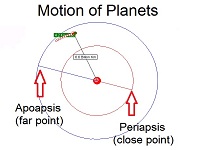
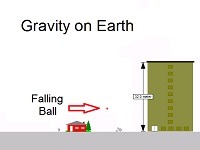
2. Mass is confined energy and energy travels at the speed of light
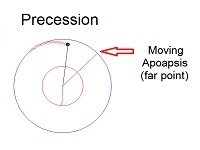
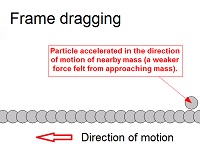
3. Energy is repelled by itself (dark energy)
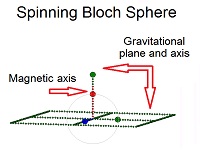
Particles
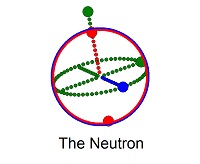
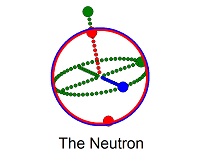
1. The Neutron - charge zero, large mass
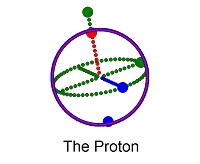
2. The Proton - charge of plus one, large mass
3. Electrons - charge of minus one, small mass
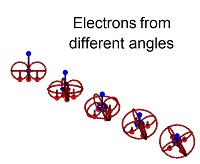
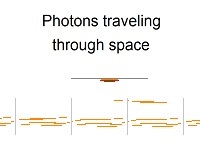
4. and Photons - no charge, no mass
Forces
1. The Strong Interaction
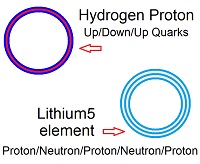
- Holds quarks together to form Protons and Neutrons
- Holds Protons and Neutrons together to form Elements (called the nuclear force that is 100 times stronger than the electromagnetic force)
The internal structure of the proton or neutron is made up of three quark layers. All baryons including the proton and neutron consist of three quarks. Mesons are made up of two quarks and are created in high speed collisions between baryons.
Elements are made from layers of proton shells separated with neutron shells (some extra neutron shells may exist). The name and charge of the element is determined by the number of protons. The mass of the element is determined by the total number of protons and neutrons.
2. Electro-Magnetism
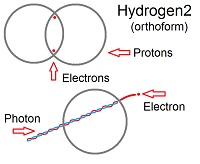
- Causes the interaction between electrically charged particles and holds electrons and protons together
- Governs the processes of Chemistry which arise from the interaction of the electrons
Electrons are attracted to a proton as free electrons under coulomb's law until they are close to a proton where they become trapped in orbitals of a specific energy level through the emission of a photon. This trapping of electrons in orbitals provides the structure to build bigger and more complex molecules. The properties of solids and liquids are determined by the structural layout of the electrons and elements.
Magnetism has a significant effect on electrons both in their motion through space and in the electrons orientation in space. In this way, electrons can be accelerated and directed to form television images.
3. The Weak Interaction
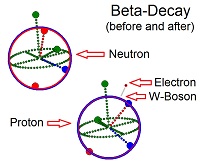
- Governed by Gauge Bosons (photons, w/z boson & gluons)
- 10 with 11 zeros after it times weaker then electromagnetism
- Governs flavor change - ie up quark to down quark in beta decay where a Neutron decays into a Proton, Electron and anti-Neutrino
Energy in the form of photons or gamma rays can emit from a particle when the particle undergoes specific changes. Particles can be transformed and new ones created through instability in a particle.
4. Gravity
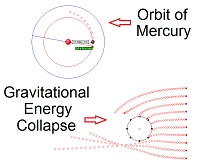
- Approximated by Newtons universal laws
- Adjusted for the fixed speed of light using Einsteins General Relativity
- Controls the creation of black holes
The Kerr metric examines the collapse of energy into a spinning black hole. The collapse of energy in three dimensions ensures that there is at least one stable size for the neutron.
The collapse of very dense energy into neutrons occurred after the inflationary period of the big bang and allowed the universe to aggregate into matter. The decay of neutrons into protons and electrons allowed matter to form the structure we see today. More..
And More
1. Colliding Particles - Baryons, Mesons and Quarks


Σ*+ uus
Σ*º uds
Σ*- dds
Protons and neutrons are in a class of particles called baryons, held together by the strong force, with a mass of about 940 MeV. Both protons and neutrons are made of three rotating up or down quark shells, attracted by the Casimir force, with gluons acting as ball bearings.
Protons and neutron shells rotate in a coordinated manner creating spin 1/2 particles (Bloch spheres are an SU(2) symmetry). The Delta baryons are also made of up/down quarks and gluons but do not have a coordinated spin producing 4 states (spin 3/2). Lambda and Sigma baryons (up and/or down with a strange quark) vary only in how their spin is coordinated. Lambda has 1 state (isospin 0) with 2 spin values (spin 1/2). Sigmas have 3 states (isospin 1) where the up and down spin is either coordinated with 2 spin values (spin 1/2), or not coordinated with 4 spin values (spin 3/2).

π+ uđ
πº uū or dđ
π- ūd

ρ+ uđ
ρº uū or dđ
ρ- ūd

K+ uŝ
Kº dŝ or sđ
K- ūs

K*+ uŝ
K*º dŝ or sđ
K*- ūs

When protons and neutrons are in high speed collisions, mesons (consisting of only two quarks) as well as baryons are created. The pion has no spin (interlocked), while the rho meson has the same quarks with independent spin. Mesons continue to decay into muons, electrons, gamma rays and neutrinos.
2. Building Elements - Protons, Neutrons and the Nucleus
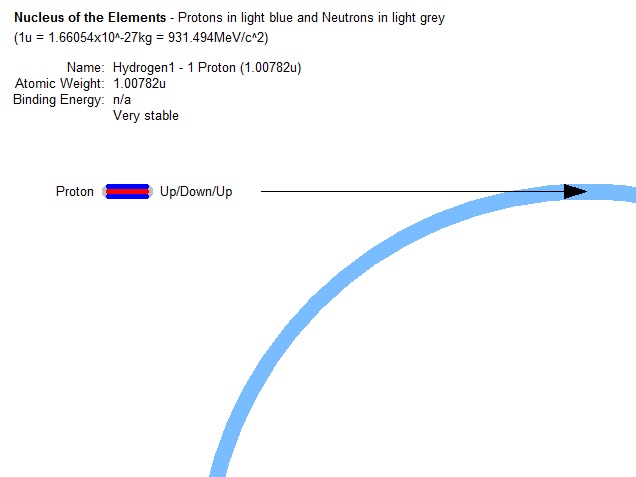
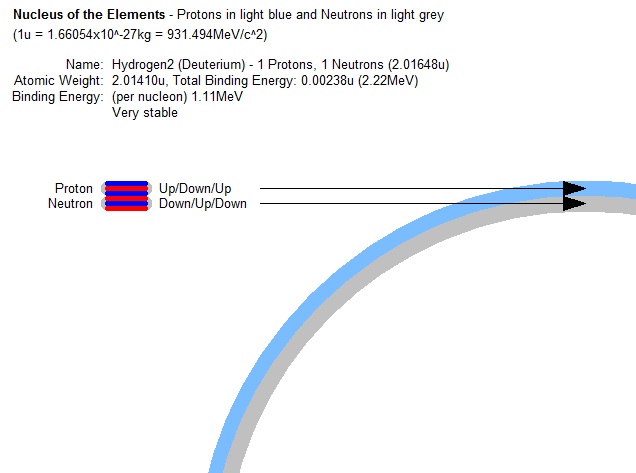

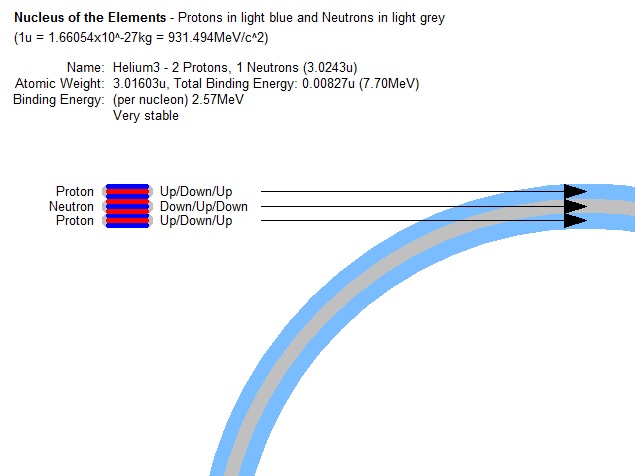
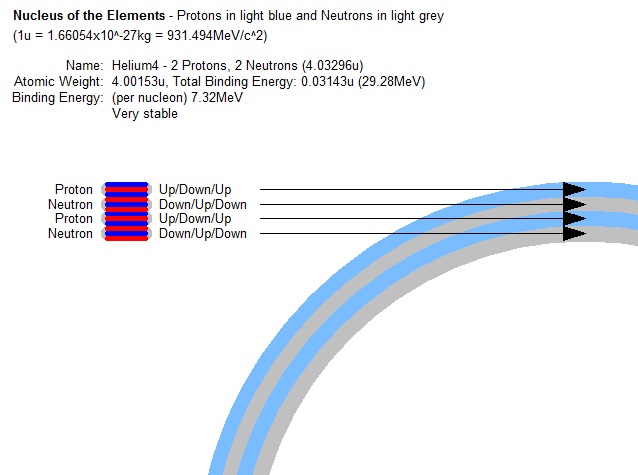
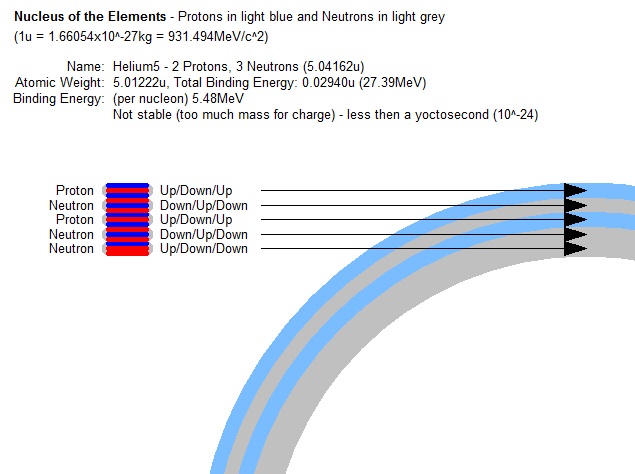
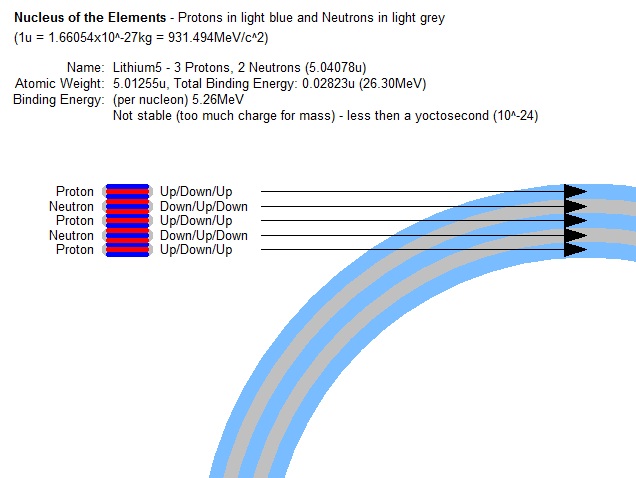
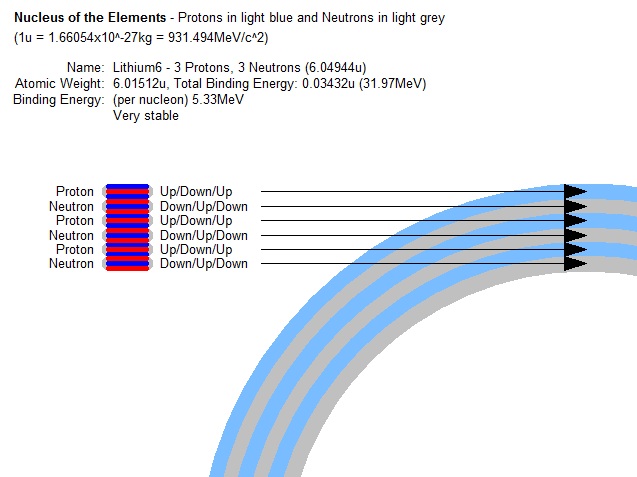
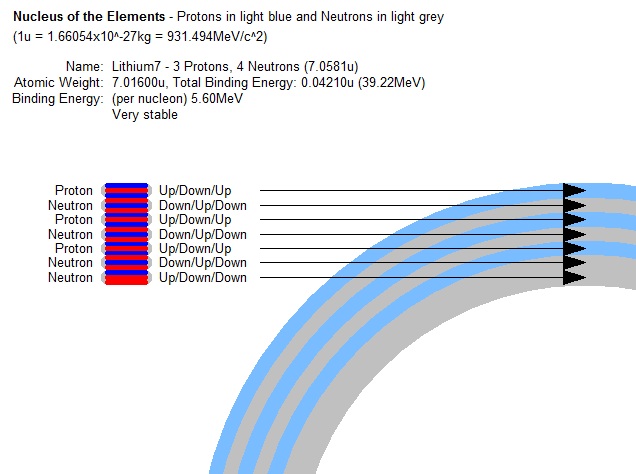
Layers of protons and neutrons form elements with the number of protons determining the charge and most of the properties of the element. Stability of the layered structures are a function of charge and mass where for example, Helium5 has too much mass for its charge and Lithium5 has too much charge for its mass.
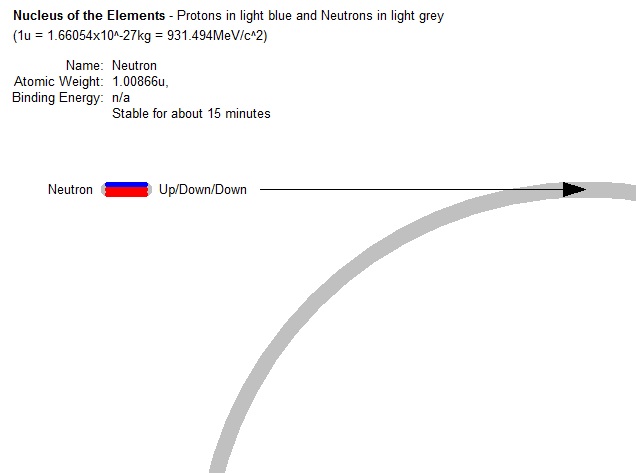
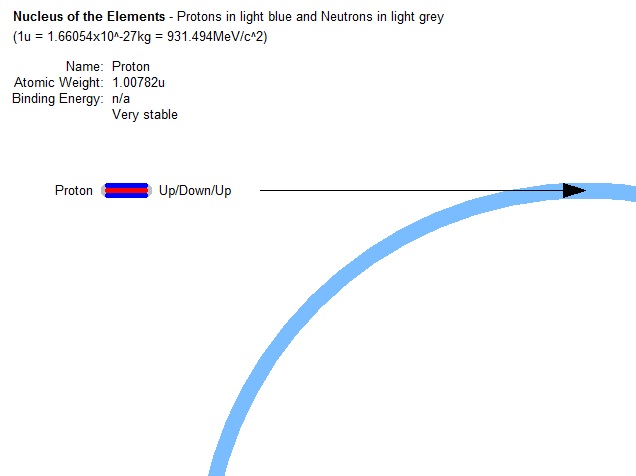

Isotopes of the elements are held together through nucleon binding energy and spin alignment. Neutron and proton interlocking spin produces higher or lower strength bonds depending on how the other neutrons and protons are interlocked.
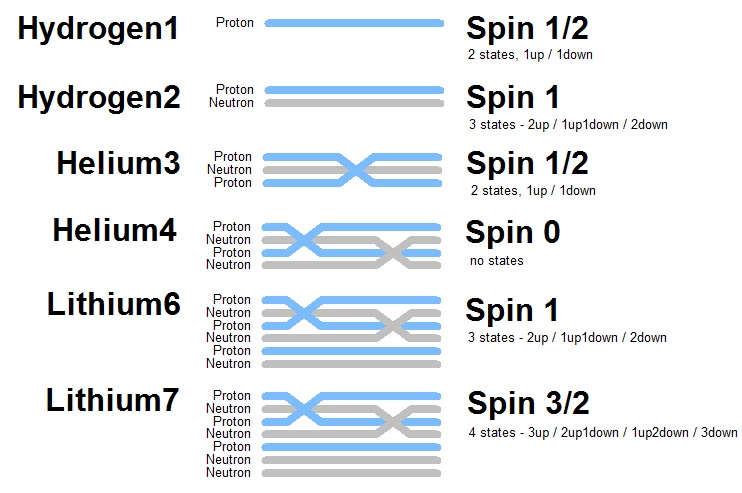
For example, the bond strength for one proton and one neutron (Deuterium or Hydrogen2) is about 1.1 MeV and forms a spin 1 particle (three states). Helium4 bond strength is almost 30 MeV (over 7 MeV per nucleon) and forms a spin 0 particle. Two protons separated by a neutron couple and two neutrons separated by a proton couple. The total angular momentum of a nucleus is called "nuclear spin". Associated with each nuclear spin is a nuclear magnetic moment which produce the magnetic interactions. The coupled protons and neutrons do not contribute to spin.
3. Energy Levels - Electron structure around the Nucleus

Falling Electron

(click to view - 1S and 2S shells)

Left alone, an electron falling into a proton, may hit the shell with enough kinetic energy to emit a photon, equal to the difference of energy inside and outside the nucleus. This photon is called the K-alpha emission and helps to uniquely identify elements. If an electron is substantially turned or accelerated due to coulomb force, it may emit a Bremsstrahlung (braking radiation) photon at various wavelengths. If the electron hits the shell with more then the energy difference inside and outside the shell, two photons may be emitted in opposite directions. The sum of the two photon energies must equal the energy difference.
The emission of the photon results in the equivalent loss of the electrons kinetic energy (slows down), often trapping the electron inside the nucleus. This area is called the 1S shell and holds at most 2 electrons with opposite spins.
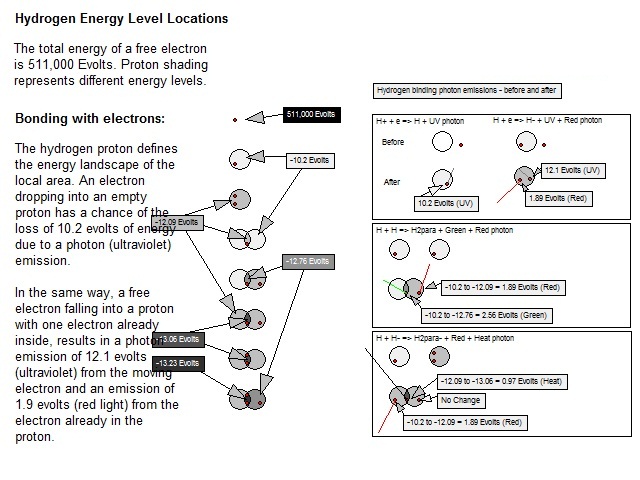
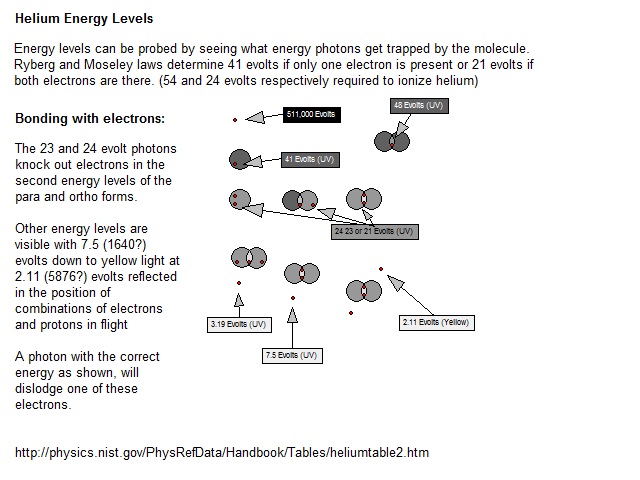
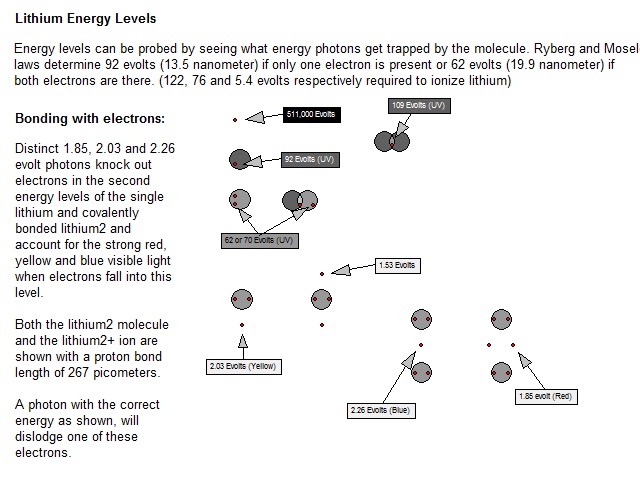
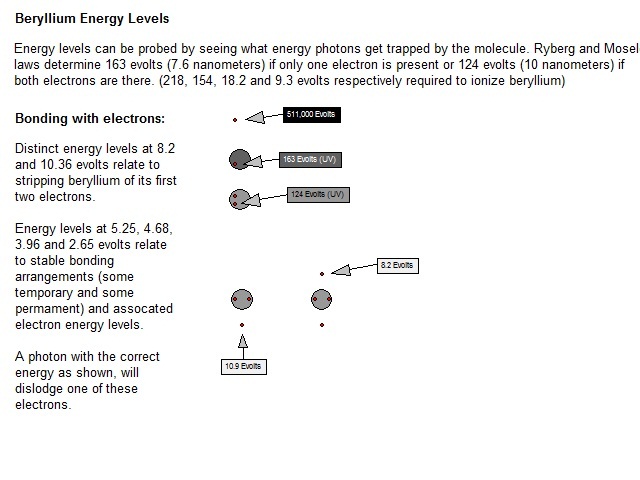
If an electron already exists inside the nucleon, then the electron drops to an even lower energy and emits a photon called the K-beta photon. The energy of the photon emitted and the ionization energy holding the electron to the proton is calculated using Bohr, Ryberg and Moseley laws.
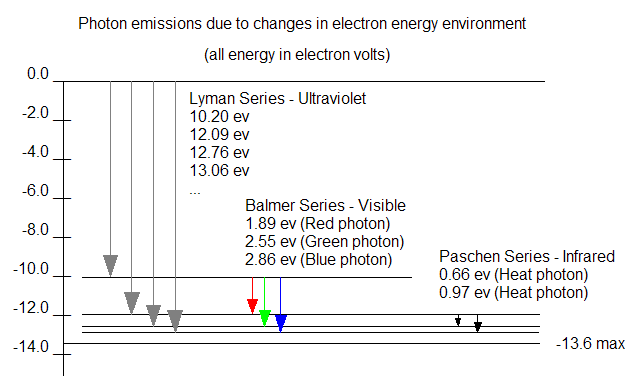
Only two electrons fit within this first energy level called the 1S level. In fact, the two electrons due to their repulsion and spin, will align themselves with the spin of the proton on opposite sides, forcing the magnetic charge of the electrons to be facing each other. A third electron can enter this region due to its own kinetic energy and will emit a slightly higher energy photon, in fact, this photon makes up the third in the "Lyman" series of emissions.
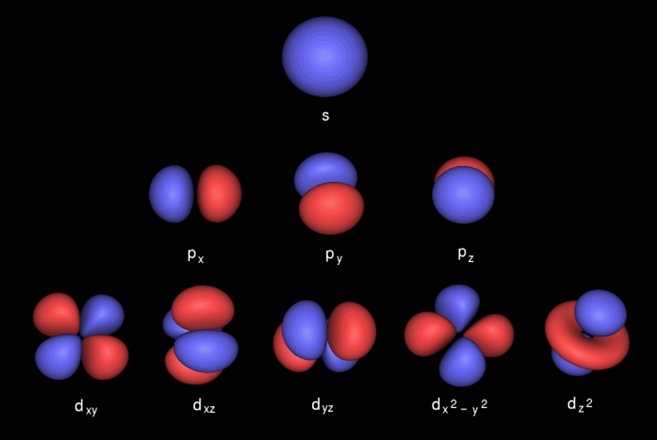
Additional energy levels are created through the interation of the nucleus and electrons, all of which are in motion.
4. Bonding - Elements, Electrons and Molecules
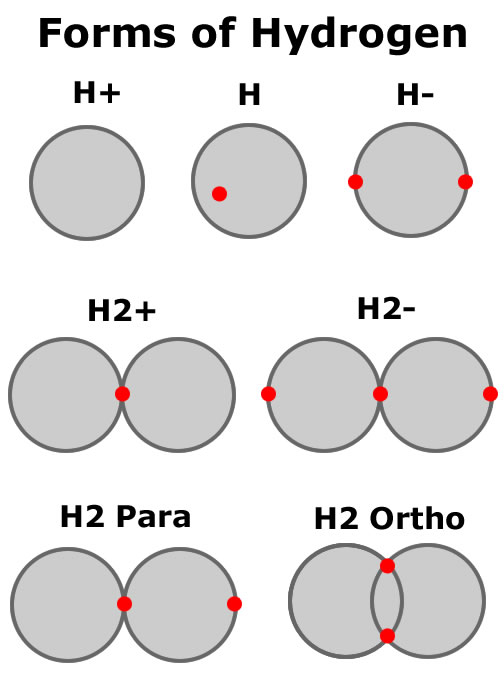

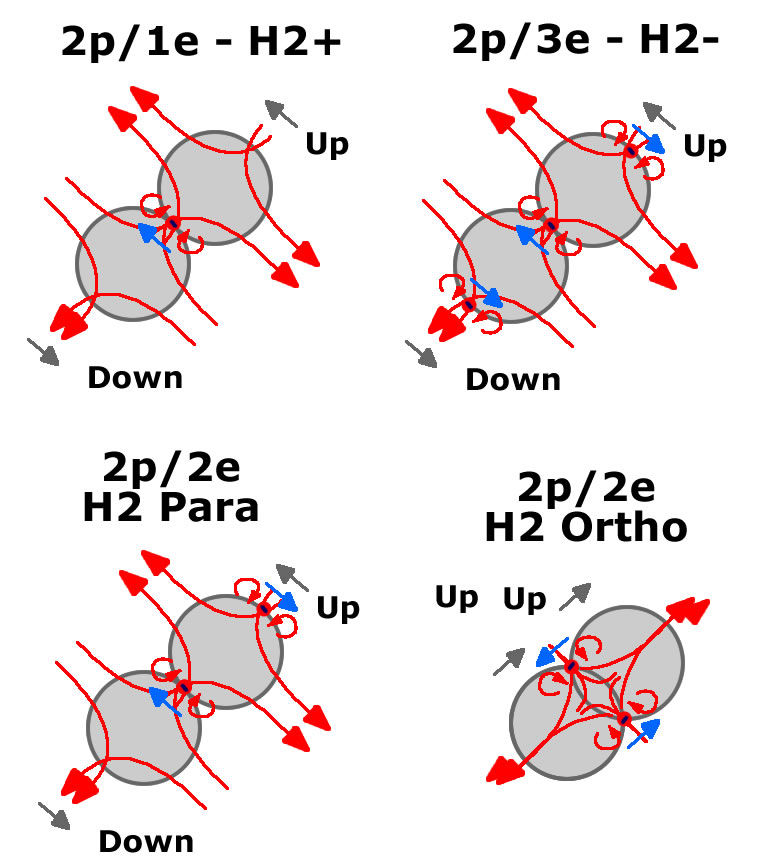
Bonding between elements occurs when an electron, trapped in an energy level of one element, gets trapped in an energy level of another element, thereby binding the two elements together.
Hydrogen consists of a proton and an electron and is neutral in charge. Although neutral, the proton acting as a shell of charge with the electron close to the edge of the shell, will attract other neutral hydrogen atoms until one electron (or perhaps 2 in the ortho form) is trapped in both hydrogen shells binding them together.
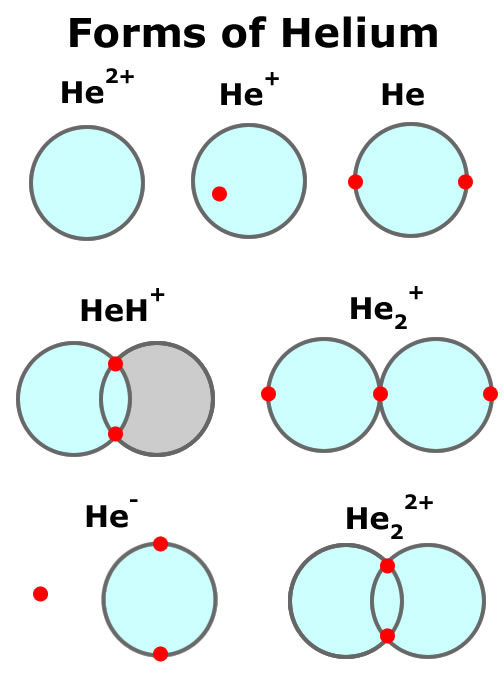
The second element, helium, consists of two protons, for a charge of plus two. Helium is very stable with two electrons in the first shell. This makes the first shell full and it will not accept another electron. Some compounds of helium will develop, for example He²+ or HeH+, but only where there is a shortage of electrons, as in a plasma.
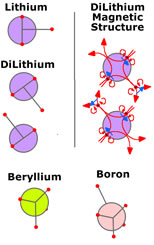
Lithium has three protons with the third electron attracted to the nucleus, but repelled by the two electrons in the first shell. Lithium atoms can pair together, to form dilithium, where a pair of electrons with opposite spin reside between the two atoms. Lithium binds with itself to form a cubic body centered metal.

5. Hydrocarbons and Organic Molecules
shells and inner structure

Organic Molecules

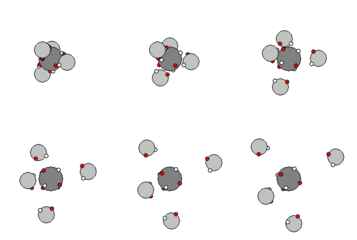
Carbon & Methane
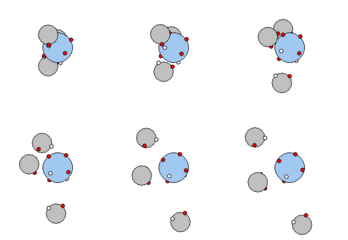
Nitrogen & Ammonia
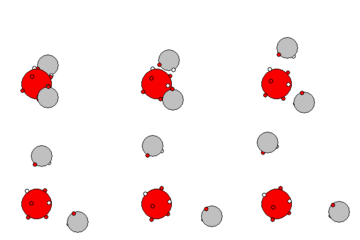
Oxygen & Water
Carbon has six protons and together with the electron shells, form a very stable structure that easily binds with other carbon nucleons and hydrogen to form hydrocarbons. In addition to hydrocarbons, carbon binds with itself in a diamond, graphic or graphene sheet solids.
The next two elements, nitrogen and oxygen, together with the hydrocarbons build the basic building blocks of life. Carbon has four bonding spots, nitrogen has three and oxygen has two, allowing for the construction of large molecular structures. Hydrocarbons consist of long chains of carbon and hydrogen where two of the bonds are for the hydrogen chain and some hold hydrogen to each carbon. Alcohols have a single bonded oxygen attached together with a companion hydrogen. Sugars integrate the oxygen into a carbon loop with two single bonds. Acids contain the alcohol bond together with a double bonded oxygen, and finally, the amino acids include a strategically placed nitrogen just beside the acid structure.
The lipids form natural cell walls and the amino acids are strung together to form peptides, proteins and eventually, cells themselves, both plant and animal.
6. Electromagnetic Radiation - Photons
when viewed headon
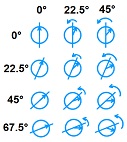
Left = polarization angle
Top = degree of "wobble"
Photons are in a class of particles called bosons. A photon travels at the speed of light in a specific direction and at a specific energy. Animated physics adds in phase, modelled as a periodic expansion in its direction of travel, up to one-half its wave length in size then down to very tiny. Photon polarization is modelled as having left or right spin, or being linear. Linear photons possess a "wobble" that started with the precession of the electron where the photon energy originated.
Tracking a single photon reveals the periodic nature that varies between particle like and wave like. A number of photons in a coherent state trapped in a cavity display a static "wavelike" nature.

